Tech stack: Python, Matplotlib, NumPy, Pandas
Project Links
Gallery
Description
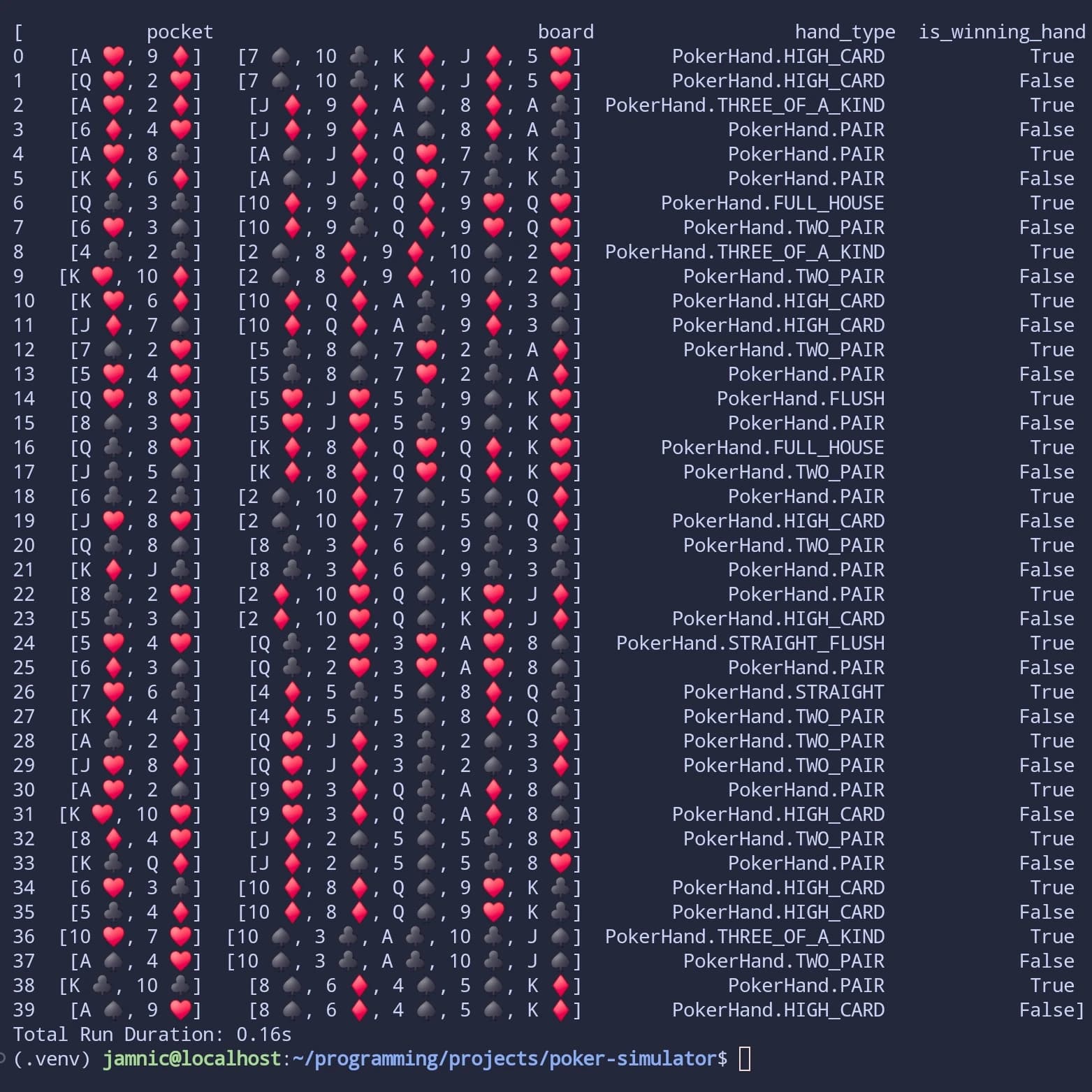
This project is a poker simulation tool designed to run pre-flop poker simulations and analyse the performance of different starting hands. It uses a Monte Carlo-style approach to simulate a large number of poker hands, dealing cards, and evaluating hands through the pre-flop, flop, turn, and river stages. The primary goal is to determine the win rates of various starting hands across multiple simulations, providing valuable insights for strategic decision-making in poker.
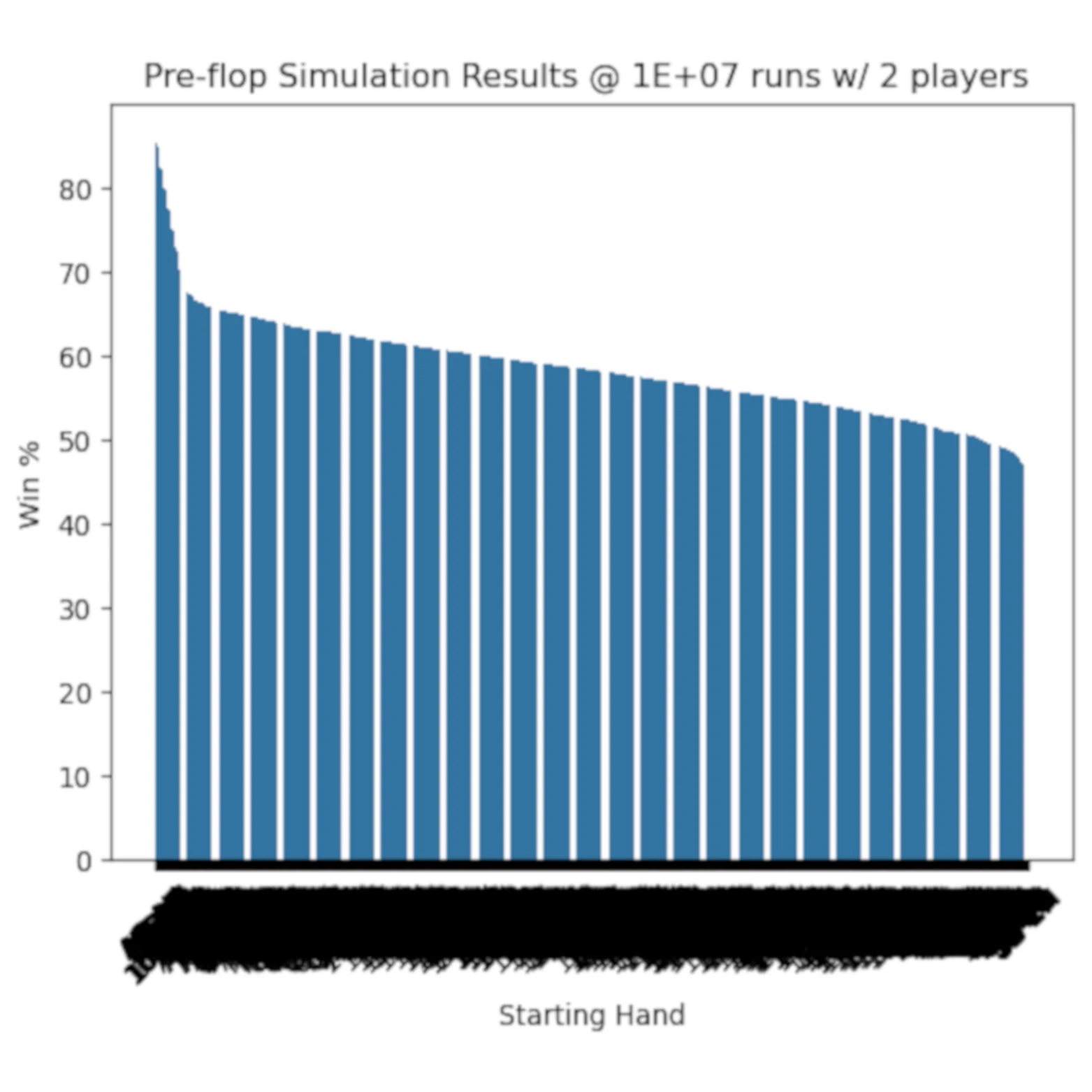
The simulation is built to run efficiently even with a large number of iterations, using parallel processing to handle multiple simulations at once. It chunks the results into manageable pieces, ensuring that memory usage remains optimised. After the simulations are complete, the tool aggregates the results and calculates the win rates for each unique starting hand, displaying the data through clear visual graphs that help users easily interpret the outcomes.
This project is a useful resource for poker enthusiasts, players, and analysts looking to better understand the probabilities and dynamics of poker hands. It allows users to experiment with different player counts and simulation runs to gather a wide range of data, making it a flexible tool for anyone interested in exploring poker strategies. By visualising win rates and grouping data based on starting hands, the tool empowers users to make more informed decisions when playing poker.
The biggest challenge I faced was ensuring that the simulation was accurate and efficient, which I overcame by writing unit tests to verify the correctness of the simulation logic and using parallel processing to speed up the calculations. It was a great learning experience in concurrency in Python and optimising performance for computationally intensive tasks.
GitHub ReadMe
Poker Simulator
The Poker Simulator is a Python-based tool designed to simulate poker hands and analyse the pre-flop win rates of different starting hands. It leverages multiprocessing for efficient batch simulations and provides graphical insights into hand statistics.
Features
- Simulation of Poker Hands: Generates random poker scenarios with players, flop, turn, and river.
- Pre-Flop Analysis: Calculates win percentages of starting hands based on large-scale simulations.
- Concurrency: Utilises Python's
ProcessPoolExecutorfor concurrent execution to maximise performance. - Graphical Visualisation: Provides a visual representation of the win percentages for each starting hand.
- Modular Design: Extensible structure for additional poker modes and custom analyses.
Table of Contents
Installation
Requirements
- Python 3.10 or higher
- Virtual Environment (optional but recommended)
Setup Instructions
-
Clone the repository:
git clone https://github.com/yourusername/poker-simulator.git cd poker-simulator -
Create a virtual environment and activate it:
python3 -m venv .venv source .venv/bin/activate # On Windows, use .venv\Scripts\activate -
Install the dependencies:
pip install -r requirements.txt
Command-Line Configuration
The simulator now uses argparse for dynamic configuration via command-line arguments. Here are the available options:
-
Player Count: Use -p or --players to specify the number of players (default: 2, range: 2-10). Example: --players 6
-
Simulation Runs: Use -r or --runs to specify the number of simulation runs (required). Example: --runs 1_000_000
-
Top Starting Hands: Use -tsh or --top-starting-hands to analyze the top starting hands (default: None, max value: 1326). Example: --top-starting-hands 20
Example Command
python main.py --players 6 --runs 100000 --top-starting-hands 20
Usage
-
Run the simulator:
python main.py -
The simulator outputs:
- Progress logs during simulation.
- Chunked results as JSON files in the created results/ folder.
- A graphical visualisation of pre-flop win percentages.
Simulation Results
The simulation was run with 2 players over 10,000,000 games. Below are the observed percentages for each hand type compared to theoretical probabilities:
| Hand Type | Observed Percentage | Theoretical Percentage | % Difference |
|---|---|---|---|
| Royal Flush | 0.0033% | 0.0032% | 0.31% |
| Straight Flush | 0.0279% | 0.0279% | 0.00% |
| Four of a Kind | 0.1694% | 0.1681% | 0.77% |
| Full House | 2.5962% | 2.5961% | 0.00% |
| Flush | 3.0279% | 3.0255% | 0.08% |
| Straight | 4.6153% | 4.6194% | -0.09% |
| Three of a Kind | 4.8237% | 4.8290% | -0.11% |
| Two Pair | 23.4836% | 23.4955% | -0.05% |
| One Pair | 43.8232% | 43.8226% | 0.00% |
| High Card | 17.4294% | 17.4127% | 0.10% |
These results align closely with theoretical probabilities for poker hands in a 52-card deck and validate the accuracy of the hand evaluation logic.
Simulation Details
How It Works
-
Game Setup:
Initialises players and a dealer, who shuffles and deals cards. -
Simulation:
Runsngames of poker:- Pre-flop cards are dealt to players.
- The flop, turn, and river are dealt on the board.
- Hands are evaluated to determine winners.
-
Chunked Results:
Saves intermediate results to prevent memory overload. -
Analysis:
Aggregates the results and calculates the win rates of each starting hand.
Key Components
-
_run_single_pre_flop_sim():
Simulates one game and returns the data as a pandas DataFrame. -
__run_pre_flop_sim():
Orchestrates the entire simulation in parallel using multiple processes. -
Graphing:
Uses grouped data to calculate and visualise win rates of starting hands.
Licence
This project is licensed under the MIT Licence.